Showing posts with label sixties. Show all posts

Thursday, October 28, 2010

Were Eight-Track Tapes a Joke?


I am pretty sure that some time in my past, I have come into contact with an actual 8-track stereo system from back in the sixties. But I can't remember it. No, my generation remembers the 8-track tape as a joke, as a metaphor for for all obsolete technology.

http://en.wikipedia.org/wiki/8-track_tape

The competing system, that eventually won out over 8-track tapes, was the compact cassette format.  They lasted into the 1990's.

http://en.wikipedia.org/wiki/Cassette_tape

Now you may notice another theme here, as part of the 8-track saga. It is the American 8-Track vs. the European Compact Cassette technology. Often, we here in North America assume American stuff is better, more advanced than European stuff, but I am not convinced at all. In so many cases, Europeans have machines that are better. I'm sure somebody could explain why, but I have no idea. But I know for sure that the 8-Track tapes were so bad that I wonder how anyone would think they could push them on an unsuspecting American consumer. Those must have been the days when it was thought that marketing muscle was all you needed, and that the actual technology could be utter crap, people would still buy them. Those days are over (I think).

Anyway, I'm getting off "track". My generation thinks of the 8-track tape as the joke. But I'm not sure my kids get the joke, as they sometimes get mixed up: 8-track or cassette, which one is the joke again? Both are pretty much obsolete, so to the next generation, both are funny. The actual joke was that 8-Tracks did not really work from day one, and the entire concept seems ludicrous in hindsight, while the Cassettes were far more functional and reliable. (and smaller, another European thing!)

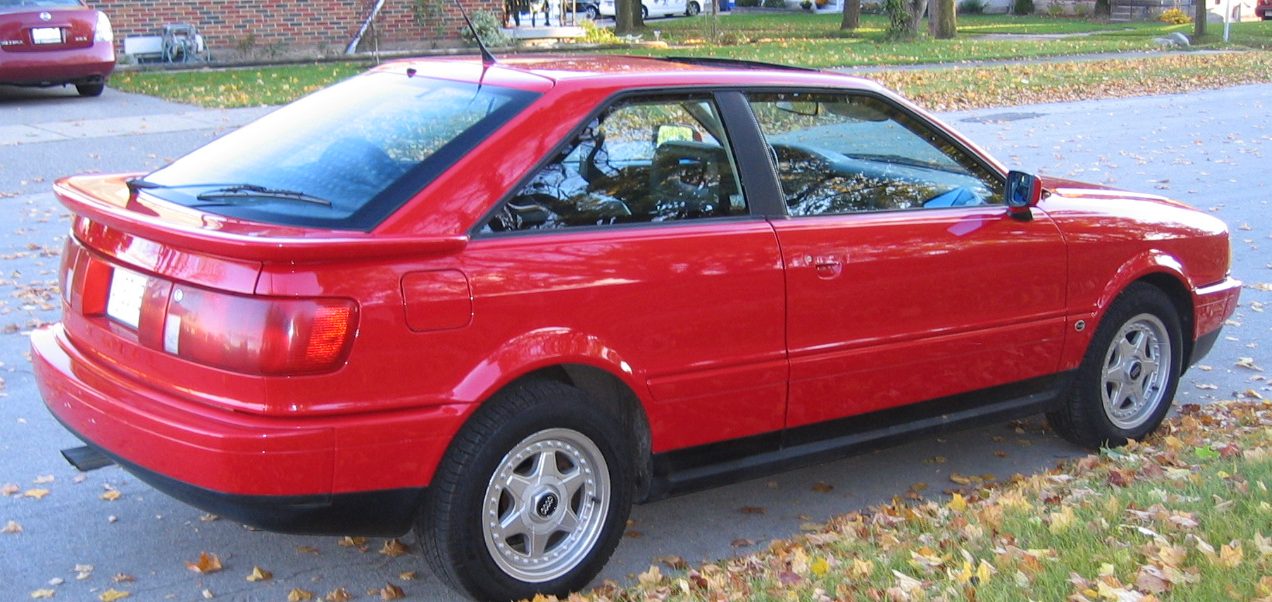
I was thinking about this last week when I took a ride in my son's 1990 Audi Quattro. This car has a definite eighties "vibe" to it. The one thing my son was worried about when buying that car was not the age, nor the mileage, but the obsolete stereo system, which he quickly replaced with a modern one so that he could stick his MP3 player in and get some music. The generation gap is large for me, because my current car, a 2005, does not have any of this modern techno-wizardry. I still have more vinyl albums than CD's, Although my turntable has been on the fritz for over five years. Oddly, my son has a functioning turntable and vinyl CD's at home, but he considers them not as a basic music source, but as an art form, or a historical collector's item. The generation gap is so bad, that I don't even understand how he uses the twin vinyl DJ turntables, let alone the MP3 player. Several years ago he gave me an MP3 player for Father's day, and I have to confess I never figured out how to use it for music, but was happily suprised when he informed me it would also work as an 8 gig memory stick.

Just getting back to the Audi, I want to remark on something about his purchase, which involved trading in a two passenger Smart car for a five seater Quattro. I have always thought of two-passenger cars as "sports" cars, and four or more passenger cars as being "regular" cars, regardless of its horsepower, no matter how good handling. But this Audi Quattro, I would say comes about as close as you can be to a sports car while having more than two seats, and the Smart Car is about as far from being a sports car you can get, while still being a 2 seater. Here is a discussion on Jalopnik, on the topic of the 4-seater sports car. (and American sports cars vs. European)

Picture: This is the picture I took of the 1990 Audi in front of our house

Tuesday, November 24, 2009

What Happened to the Sixties?

The movie "Easy Rider" in 1969 featured a couple of guys on motorcycles, heading out to experience America. They had enough money that they did not need to get a job, which was a popular fantasy at the time. But in the end, the Easy Riders are killed by gun-toting, pickup-truck-driving (and presumably ignorant) rednecks. Is this what happened to all the the ideas of the sixties?

During the sixties, some Americans became aware that with their increasing wealth and higher standard of living, that one day "work" may be a thing of the past. The idea was that machines would do the work, and people would have lots of leisure time, and be able to enjoy life in the future rather than spend their lives accumulating goods. The sixties were an idealistic time, where civil rights for black people had been achieved, and where the "war on poverty" was being waged. With the new generation of baby boomers reaching late teen years, new ideas were everywhere. Some of the ideas included sex, drugs and rock and roll. The future looked like peace and love.

Today, forty years later, instead of peace and love, we have some war and plenty of hate. The war on poverty turned into the war on drugs, with a holy war thrown in just for good measure. Leisure time is not valued all that much, and most people prefer just to accumulate material possessions. What became of the dream of leisure time? Now parents need to put their kids in day care so that they can work enough jobs to buy the stuff they "need".

I'm guessing that near the end of the seventies, when it came right down to the decision, most of the flower power generation opted for consumerism.

Another sixties idea was the "Back to the land" movement. This idea was that you did not have to get a job and work for money, you just moved to some land, and built your own house, grew your own food, and became self sufficient. It was an idea doomed to failure from the start. Not only did most people lack the skills, but they did not realize that farming was unpleasant hard work. Then you have babies and suddenly the concept falls flat.

The backlash to the naive "Back to the Land" movement was strong, and possibly persists to this day. As the flower power generation hit their thirties, suddenly jobs were back in style, "dressing for success" was popular, and anyone who was not a consumer with a paying job was to be pitied.

Eventually the trends will swing back again, though probably not to the extreme "back to the land" ideas. We could do with a healthy dose of frugality, eliminating wasteful consumption, learning to repair and recycle things. And we need to learn how to handle leisure time in a sustainable way. For example, people could use some of their leisure time to learn about the world around them instead of grabbing mindless sound bites off Fox News.

The reason the days of wasteful over-the top consumerism are numbered is simple. Consumerism now makes no more sense than the old Back to the Land ideas any more. In spite of the slogan "Drill, baby, drill", oil production has peaked, the climate is changing, jobs are evaporating, and people still with jobs are overworked. Overworked people are not thinking people. It's pretty obvious that extremist doomsday religions are gaining stronger footholds, and ignorant, dissatisfied people tend toward aggressive displays to make up for their lack of understanding of the world around them.

It's too bad we had to go down this road of mindless consumerism for thirty years. It's even more of a dead end than "Back to the Land".

Friday, May 1, 2009

My 100th Blog Entry

I can't believe I have posted 100 blogs since I started on November 30, 2008. My subjects have been mainly related to motorcycling or propaganda. Motorcycling has included driving tips, technical stuff, nice roads and bikes. The propaganda started with some myths about Nazi propaganda and also included some current propaganda, religion and politics. Because I consider all those to be bound up with propaganda. I ended up with over 20 blogs about propaganda alone.

2009 is the fortieth anniversary of my first year as a teacher and a CUSO volunteer in in Sierra Leone. I found out that the current president of Sierra Leone, Ernest Bai Koroma, might have been in my class at Magburaka Secondary School for Boys in 1969. He attended that school, and was 16 in 1969, the year I started teaching there. I don't have the actual class registry, and it's too long ago to remember all the names, but I do remember a few "discussions" on politics in my Physics class - proving once again that I have a hard time sticking to one subject. I am hopeful that he turns out to be a good president, Sierra Leone deserves it.

I also found a current picture on the Internet of my old house on the MSSB school compound, which has been partly destroyed by the war in the nineties. That war finally ended when Tony Blair sent British troops in on a peacekeeping mission. Some good things can be achieved by peacekeeping, but there is a right and a wrong way to go about it. I want to congratulate Tony Blair and the British peacekeepers for doing it the right way.